Wednesday, 10 April 2013

Britain and the 'war on terror' throughout the ages

A review of the Oxford Literary Festival 2013

Dr Brydon - the only survivor of the 18,000 strong British retreat from Kabul in 1842


There is an unfortunate tendency in this country – including, perhaps especially, on the ‘left’ – to think of the ‘war on terror’ and its attendant horrors as a US crime. Abu Ghraib, Guantanamo Bay, drone strikes…all have become bywords for US atrocities; virtually household names. But how many are aware that the modern system of secret prisons, the interrogation techniques used in the prison abuse scandals, and the use of aerial bombing to suppress resistance, were all pioneered by the British, and still used by British governments today? Likewise, US-sponsored coups in Guatemala and Chile are notorious, as is the Vietnam war – but British crimes, in Malaysia, Kenya, Korea and elsewhere remain largely hidden from public discourse (despite valiant attempts by such historians as John Newsinger and Mark Curtis).
                So it is good to see a number of authors at the festival tackling the specifically British role in the perpetration of bloody injustice across the centuries.
                The path that led journalist Ian Cobain to write “Cruel Britannia: A Secret History of Torture” began with his reporting on   a number of ‘terrorism trials’ over the past decade. He noticed that identical accounts about the presence of MI5 officials in between bouts of torture in Pakistani jails began to emerge time and again from the defendants in these trials. Each time, after a bout of torture, two British men would enter the room and introduce themselves. They would question the suspect for ten minutes or so, during which time no physical mistreatment would take place. They would begin by asking the same set of questions as the Pakistani interrogators had done during the torture, but would then move on to a set of new questions, before leaving the room. The torment would then begin again, with these new questions forming the basis of the next session of interrogation and torture. After travelling to Pakistan to meet the lawyer of one of the accused – who confirmed that torture is standard for terror suspects in the country, as is the presence of MI5 officials in the case of British citizens – he began to suspect there might be an official British torture policy. Eventually, he discovered that there was – the “Agency policy on liaison with foreign intelligence service in relation to suspects who may be subject to mistreatment”, created by the Labour government in 2002 to allow British agents to interrogate prisoners undergoing torture. The discovery of this document then led him to look further back, discovering that Britain had run a string of secret prisons during World War Two in locations such as Berlin, Hanover, Cairo and Casablanca, as well as an interrogation centre in Kensington Gardens where not only defendants, but also witnesses, at war crimes trials were regularly tortured. Intriguingly, the wartime organization set up to run these secret prisons – the Combined Services Detailed Interrogation Centre – preceded the establishment of a US organization of the same name, and trained its staff. Not surprisingly, the techniques of torture were then honed during the brutal suppression of rebellions in the colonies. What became known as the ‘five techniques’ – hooding, sleep deprivation, starvation, stress and noise – the very techniques so familiar to us from recent images from Iraq – were crafted during Britain’s colonial wars in Kenya and Malaya in the 1950s – with the fifth technique being added in 1970 in Ireland. The legal case around the death of Baha Mousa in British custody in Iraq revealed that these techniques are still being used today.  

Victoria Brittain’s latest book “Shadow Lives” also deals with the British role in the war on terror, not so much its impact on British citizens abroad, as on foreign citizens in Britain - specifically, the families of people placed under ‘house arrest’. Initially, in the weeks following September 11th, the British government decreed that foreign citizens could be detained without charge indefinitely. This policy was ended by the House of Lords, and the government’s response was the introduction of “control orders”, a form of house arrest whereby the victim of such an order must stay in their house – indeed, often in only one specific portion of their house – for almost the whole day, with just a short window for leaving the house to travel only in the immediate surrounding area. Any visitors to their house must have gained prior approval from both the Foreign Office and the security services. As Brittain pointed out, when one member of a family is under ‘house arrest’, in effect “the whole family is put under house arrest”. Since these laws, however, only apply to foreign nationals, the British government ingeniously passed a law in 2003 to allow the government to strip British citizens of their citizenship. Theresa May has been particularly keen on using this law, and as the Independent exposed recently, has used it 16 times since coming to office. Two of those stripped of citizenship went on to be killed in drone strikes abroad, but as they were no longer ‘British citizens’, the government was able to wash their hands of any responsibility. Brittain discussed in particular the example of Mehdi Hashi, a young Somali-British man who grew up in Kentish Town, who was stripped of his British citizenship last June and has now very likely been subjected to ‘extraordinary rendition’ in Somalia.

The novelist William Sutcliffe, sharing the panel with Victoria Brittain, noted that this model of turning people into ‘non-citizens’ in order to strip them of their rights, is precisely the Israeli method of dealing with Palestinians. Palestinians are not citizens of any state, and therefore have access to neither the minimum wage, nor to civilian courts, subject only to Israeli military law, where they are not allowed to see the evidence against them, and the conviction rates are more than 99%. Sutcliffe’s novel ‘The Wall’ is set in a “mythical version” of the West Bank, where Joshua, a Jewish boy living next to the apartheid wall, who has grown up being told the other side is full of unimaginable horrors, one day finds a tunnel underneath, and ventures down it. Thus, Sutcliffe explains, the novel is an inversion of the classic ‘fantasy portal’ plot – rather than the portal (tornado, wardrobe) providing a way out of mundane reality and into a world of fantasy, the tunnel provides an escape from his fantasy life and into a world of brutal reality. Sutcliffe said he was drawn to the Wall as a setting for his story as it epitomized the “division between haves and have-nots [which] seems to be the story of our times”.

The other story of our times – and one similarly symbolized by the apartheid Wall – is the story of occupation, imperial hubris and the illusion of military security. As Michael Burleigh explains, in a discussion of his latest book “Small wars, far away places”, the “conceit” of the British is that “we think we know how to fight counter-insurgency wars”. The British love to contrast their supposed ‘success’ in Kenya and Malaya with French and US failures in Algeria and Vietnam, but, Burleigh reminds us, this was not so much down to technique as luck. Whereas the French were up against genuinely national mass movements in Vietnam and Algeria, the British were fighting movements rooted in a particular ethnic minority (the Kikuyu and the Chinese Malays) – and even then, it still took them twelve years to achieve victory in Malaya. The British delusion remains, however, that victory was actually due to success in ‘winning hearts and minds’, combined with superior intelligence and special services. The other delusion, of course, surrounds the reasons for the war. Burleigh notes that the Malayan war (1948-60) was a war to maintain the exploitation of Malayan tin and rubber, pure and simple. The dollar-earning capacity of these industries was necessary “to build the New Jerusalem, whilst retaining a ‘place at the top table’ in foreign affairs – and Attlee and Bevin shared that goal as much as any Tory imperialist”. Likewise, Burleigh notes, “one is struck by the air of self-congratulation that surrounds decolonization”. The reality is that decolonisation was forced on Britain, who then proceeded to make a mess of it, “screwing up” the partitions of India and Palestine, leaving “legacies that haunt us to this day”. These things matter, says Burleigh, because our failure to understand the reality of the disasters created by our past colonial wars, means we remain deluded that we have the ability to impose military solutions on “faraway places” today.

William Dalrymple’s latest offering “The Return of the King” – a new history of Britain’s doomed occupation of Afghanistan between 1839 and 1842 – suffers from no such delusions. Based on meticulous research - referencing no fewer than nine previously untranslated contemporary Afghan accounts of the war – Dalrymple offers a blow-by-blow account of the biggest British military disaster of the nineteenth century. He explains how, just as in 2002, the relative ease with which the ‘fall of Kabul’ was accomplished lulled the imperial troops into a fatal complacency. A fort was established in a completely indefensible valley, such was the “smugness” of the British occupiers. Things started to go wrong, however, when austerity started to bite. As Dalrymple explains, it is not the conquest of Afghanistan that is difficult – “The Greeks, the Turks, the Mughals, Nadir Shah, all conquered Afghanistan”, he reminds us. “What is impossible is paying for the occupation of Afghanistan.” Unlike Iraq, there are no oil wells to loot; and unlike India, there are not enough productive farmers to tax: the army of occupation cannot be paid for by the exploitation of native people and their resources. It drains money. The East India Company, in charge of the operation, was making a fortune selling India-grown opium to China, but its entire profit ended up being poured into the Afghan adventure. So, then as now, the British began training an Afghan army “to keep the puppet in place” – and then expropriated the local nobles to pay for it. In addition, they cut the subsidies being paid to local tribes in order to keep the passes open. The last straw was when the occupying army began “turning Kabul into a brothel”. If they are not stopped, wrote one Afghan chronicler, “the English will ride the donkey of desires into the field of stupidity”. Armed insurrection followed - and the rest is history. Within 24 hours, the British army’s supplies and ammunition stores had been captured. Under bombardment from the surrounding hills, the garrison ate “first the beagles, then the horses, and then the rats” - and then surrendered. Of the column of 18,000 who embarked on the long retreat out of the country, only 1 reached their final destination (Dr Brydon), the rest having either been shot, frozen, starved or kidnapped en route. Al Qaeda’s chilling warning to the latest generation of occupiers – that “this time, there will be no Dr Brydons” was universally understood by all the Afghans who heard it. Zawahari, the Al Qaeda leader who made the comment, well understands the link between occupation and the draining of resources, and drawing the West into expensive and unwinnable wars is the key tenet of his strategy for bringing down the infidels and their Empire. He is certainly familiar with the lessons of the 1842, as expressed so succinctly by Mirza Attah: “The English love gold and money, but what did Afghanistan bring them other than the exhausting of their Treasury and the disgracing of their army?”

Dalrymple finishes his talk on a salutary note: he reports that China has just bought up the mining rights to Afghanistan, and thus “by doing business without sending in a single soldier, I think the Chinese will succeed where Britain has failed four times over”. The question is - will the British learn the lesson?

An edited version of this article first appeared in the Morning Star

Wednesday, 19 December 2012

The People’s Spring: The Future of the Arab Revolution by Samir Amin

Book review
Samir Amin: "The last Marxist in the Arab world" according to a friend of mine!

The timing of this book couldn’t have been more appropriate. Amin has been writing about the use of political Islam as a tool of imperialism to undermine secular regimes for years, but in the decade following the second intifada of 2000, when armed jihad was raging against US, British and Zionist forces from Basra to Helmand, the thesis seemed counter-intuitive to say the least. The events of the past year and a half, however – with Islamists again acting as imperialism’s shock troops, in Libya and Syria, whilst simultaneously pushing neoliberal globalization to parts of Egypt even Mubarak couldn’t reach – have shown that ‘political Islam’ is as useful to imperialism as ever.


This book charts the development of the Middle East, and Egypt in particular, over the past 2000 years, from its rise and fall as a ‘hub’ of the world’s trading systems, through its stop-start attempts at modernization during the nineteenth and twentieth centuries, to the decline that followed Nasser’s defeat in the six day war. But the most interesting sections are those tracking the developments of the last 50 years.

Intriguingly, 4/5 of the book was written before the social explosions of early 2011. By outlining the growing social pressures and conflicts which preceded them, Amin shows that the explosions were, in fact, far from unexpected. But he also shows that if the capture of these uprisings by the Muslim Brotherhood was not exactly destined (Amin does not believe in such things), it was also eminently predictable.

Since the time of Sadat, Amin argues, the Egyptian state has actually been complicit in the growth of the Muslim Brotherhood’s power. Nasser’s defeat in 1967, and his death in 1970, resulted in a capitulation to imperialism, and a corresponding decline in living standards – and in the regime’s legitimacy. To compensate, the state sought instead to gain religious legitimacy by systematically handing over powerful institutions – namely television, education and the courts – to Islamist control. This whole process deepened following the collapse of the USSR, which led to a fresh wave of neoliberalism and impoverishment, along with a renewed attempt to channel opposition in a purely religious direction. Thus, for Amin, the apparent ‘contradiction’ between the Sadat-Mubarak state and the Brotherhood is pure theatre – Egypt has been run by what amounts to an alliance between the two forces for a long time.

Imperialism, meanwhile, has been complicit in the process, allowing its Saudi friends to pour money into the Muslim Brotherhood, who are then able to provide essential services (such as healthcare) where the state has been forced by IMF diktat to cut back. Today, they fully support the Brotherhood’s takeover of the country. As Amin explains, “the single aim of Washington and its allies Israel and Saudi Arabia is to abort the Egyptian democratic movement, and to that end they want to impose an Islamic regime under the direction of the Muslim Brotherhood – the only way for them to perpetuate the submission of Egypt”. The Brotherhood – through their full support of Empire regime change policy in the region and the reduction of the Egyptian economy to an informal ‘bazaar’ market system – are the perfect allies for Empire in its quest to push back the possibility of Egypt’s emergence as a strong, independent state. Their programme is one of capitulation to the US military and globalized capital, whilst upholding the Zionist status quo. No wonder Cameron and Hague are so gushing in their support. 

An edited version of this article first appeared in the Morning Star

Sunday, 9 December 2012

The Utopianism of Reforming Capitalism


Book Review: "What We Are Fighting For: A Radical Collective Manifesto" – ed by Federico Campagna and Emanuele Campiglio


What We Are Fighting For consists of 20 short articles written by various thinkers and activists connected with the anti-austerity and Occupy movements that have emerged in recent years.

Where it is at its best, it is essentially Marxism in disguise. Michael Albert’s ‘balanced job complexes’ is a concise reformulation of what Marx described as ‘ending the division between mental and manual labour’, whilst Richard Seymour’s discussion of the ‘new model commune’ essentially outlines the functions of the early Soviets.

Occasionally, the Marxism is overt. Peter Hallward’s defence of the notion of the ‘dictatorship of the proletariat’ is a useful reminder that radical forces will be viciously crushed if they ever start to make an impact – and as the author of a detailed study of the repression of the Haitian popular movement in recent years, it is a lesson with which he is all too familiar.

Where it is less good is where it neglects class analysis altogether. Some writers fall victim to the all-too-prevalent trap on the left of treating neoliberalism as a policy choice, rather than simply the natural expression of crisis-era capitalism. The danger here is that this can lead to a deradicalised nostalgia for the days of Keynesianism: not only uninspiring as a vision of a future society, but impossible to deliver for a capitalism operating in a different economic climate – not to mention the immorality of demanding a return to a social democracy that was predicated on colonial and neocolonial exploitation. Pettifor even presents 1930s USA and Britain as models, as they “threw off the chains of private banking” by, in the case of the British Tory administration, leaving the Gold Standard. But a ruling class forced by workers’ revolt – mutiny in this case - to adopt measures to save its own skin should hardly operate as the yardstick of progressiveness.  One wonders what those who were on the receiving end of means tests and benefits cuts would make of this depiction of the 1930s as an era of progressive government.

Owen Jones is also here, employing his masterly trademark combination of stating the bleeding obvious whilst totally missing the point. A new working class movement must, he tells us, demand well-paid jobs. Thanks Owen!

The problem with presenting the capitalism that existed thirty years ago as some kind of ‘radical alternative’ is that it thoroughly emasculates the term. Certainly critiques of neoliberalism are useful – but only if neoliberalism is properly understood as the mechanism of bourgeois exploitation in the era of capitalist crisis, and not simply an unfortunate and misguided policy choice.

As Alberto Toscano points out in his contribution, it is today precisely reformism – with its dreams of reinstating a system that was the product of entirely different social conditions – that is now utopian, akin to demanding that the sun come out at midnight.

Where the book succeeds, then, is less in its analysis and more in its commitment to the process of beginning to map out alternatives to capitalism. The Mondragon cooperative movement in the Basque country and practical examples of democratically controlled finance from Vietnam make Milford Bateman’s chapter interesting reading. Shaun Chamberlain highlights the importance of creating counter-narratives to challenge the hegemony of ruling class mythology and posits that our “fundamental challenge” lies in “challenging and changing the stories that define success, identity and meaning in our culture”. David Graeber develops this theme by arguing for the need to redefine certain key terms that have been colonized by the enemy, such as work, democracy and communism, to rescue their meanings from the parodies they have been reduced to by the ruling class.

A further theme that emerges is that of democratization of the economy: emphasizing the fact that capitalism is a fundamentally authoritarian institution, in complete contrast to its own pious claims; and self-government, therefore, is its antithesis. Albert’s contribution, sketching out what a genuinely participatory economy might look like, succeeds in opening the debate as to how a socialist society might actually work.

There are other interesting suggestions here: Dan Hind, for example, discusses the practicalities of organizing a democratic, publicly commissioned mass media. Whilst not possible until after a revolution, in my view, envisioning post-revolutionary possibilities is nevertheless a worthwhile activity; and, far from being an exercise in pie-in-the-sky utopianism can actually become a motivational subjective force for revolution in itself. The danger is that without a revolutionary outlook behind such ideas, there is always the possibility that these ideas can be embraced, neutered and sold back to us by a capitalism hungry for new ideas; as Campagna puts it, “capitalism [always] manages… to follow our requests to the letter and to return them to us realized, if slightly modified. That slight modification, as we all know, is the tiny poison pill that turns all our ‘realized’ demands into even tighter chains.”

The book’s tagline is a misnomer: it’s clearly not a manifesto. But it is a step towards the kind of debate necessary if one is to be written. 

Wednesday, 22 August 2012

British policy towards the Arab Spring has been entirely consistent

 
David Cameron with Sheikh Hamad bin Khalifa al-Thani, whose family have ruled Qatar as an
absolute monarchy since being installed by the British 150 years ago.
Over the past year, the British government have bombed rebels into power in Libya –and are desperately hoping to do the same in Syria–whilst simultaneously aiding and abetting the crushing of rebel forces in Bahrain and Saudi Arabia. Some commentators have called this hypocritical. In fact, there is no contradiction: the British government is engaged in a vicious, region-wide attack on all independent, anti-colonial forces in the region, be they states or opposition movements. Client regimes – in many cases monarchies originally imposed by the British Empire – have been propped up, and states outside the orbit of Western control have been targeted for destruction. The policy, in other words, has been entirely consistent: a drive towards the total capitulation of the Arab world; and more specifically the destruction of any potential organised resistance to an attack on Iran. What is more, it has been planned for a long time.
The Arab spring did not come out of the blue; it was both predictable and predicted. All demographic, economic and political trends pointed in the direction of a period of instability and civil unrest across the region, and especially in Egypt. The combination of growing and youthful populations, rising unemployment, corruption and unrepresentative government made some kind of mass manifestation of frustration a virtual certainty – as was recognised by a far-reaching speech by MI6-turned-BP operative Mark Allen in February 2009. In August 2010, Barack Obama issued Presidential Study Directive Number 11, which noted "evidence of growing citizen discontent with the region's regimes" and warned that "the region is entering a critical period of transition." Four months later, Mohamed Bouazizi set himself on fire in Tunisia, sparking off the unrest that led to the downfall of President Ben-Ali.
For the world’s imperial powers, wracked by their own economic crises – Britain, France and the US– it was clear that this unrest would present both a danger and an opportunity. Whilst it threatened to disrupt the Gulf monarchies imposed by Britain during the colonial period (Bahrain, Qatar, Saudi Arabia, Kuwait et al), it could also create the ideal cover for the launching of long-planned proxy wars against old enemies.
Both Libya and Syria have long been considered thorns in the side of Western world domination. It is not only their policies –from Gaddafi’s consistent opposition to US and British military bases in Africa to Assad’s support for Palestinian liberation groups – which riles Western policy makers, but the mere fact that they have independent governments which are able to formulate and implement such policies. In the eyes of the world’s unelected and undeclared ruling elites, for a government of the global South to be either strong or independent might be just about tolerable - but not both.
Secret Anglo-American plans for the overthrow of the Syrian government - using proxy forces directed by Western intelligence, and carried out under the cover of‘internal disturbances’ - have been in place since at least 1957. More recently, the US has embarked on a policy of funding sectarian Salafi militias to wage war against the region’s Shi’ites in order to undermine Iran, destroy the Syrian state and cut off Hezbollah’s supply lines. This policy was a direct response to the two major setbacks of the previous year – the massive wave of attacks on Western forces by Sunni militants in Iraq and Israel’s defeat in its war with Hezbollah. In a prophetic piece in 2007, Seymour Hersh shows how the US, Israel and the Saudis hatched a plan to‘redirect’ Sunni militias away from their fight against the US and towards Syria. As one US government consultant put it, “it’s not that we don’t want the Salafis to throw bombs; it’s who they throw them at—Hezbollah, Moqtada al-Sadr, Iran, and at the Syrians, if they continue to work with Hezbollah and Iran.”
The coming of the ‘Arab spring’ provided the perfect cover for the throwing of these bombs – and for the British and US government plans to be put into effect. They acted quickly; armed attacks began in both countries within days of the ‘protest movement’ erupting, carried out by insurgents with longstanding links to British intelligence and increasingly trained and directed by the SAS and MI6.
Acting under the cover of the Arab spring also proved a winning formula for Western governments to mobilise support for ‘humanitarian intervention’ – the twenty-first century white man’s burden. Bush and Blair had given Western warmongering in the Middle East a bad name, but by implementing proxy wars –and aerial blitzkrieg - under the guise of ‘support for popular uprisings’, it was possible to ensure that liberals and ‘socialists’ by and large fell in line (albeit with some tactical differences on occasion). Frustrated Western radicals, desperate to vicariously experience the ‘revolution’ they know they would never – and let’s face it, would never want to – actually be involved in, lapped up the imagery of the‘people versus the dictator’. These ‘useful idiots’ all helpfully provided a veneer of credibility to the new wars that was clearly lacking in the case of Iraq.
The method of ‘proxy war’ – using militias recruited from the local population to fight for imperial interests – has long been the favoured policy of British policy planners – in contrast to the more ‘gung-ho’ boots on the ground methods of the US.
The war against Libya gave the ‘Arabists’ who dominate the British Foreign Office (the FCO) a chance to show the Americans how it is done. They have always preferred to cultivate local allies on the ground to do the fighting and dying – it’s cheaper, less unpopular at home, and so much more subtle than the blunt, blundering and cretinous approach of the Bushblair posse. Indeed, the FCO opposed the Iraq warfor precisely this reason – there was no moral, nor even strategic, disagreement – but a tactical one. The perceived failure and cost (in both blood and treasure) of Iraq thus allowed the ‘Arabists’ to gain the upper hand for the next round of colonial war that is now unfolding.
Meanwhile, client regimes – those monarchies established by Britain in the dying days of Ottoman control of the region – were given all the help they needed to drown their own uprisings in blood. Britain sold Saudi Arabia no less than £1.75 billion worth of arms last year – arms that are now being used against protesters in both Saudi Arabia and Bahrain, where the Saudis invaded last autumn to crush the growing democratic revolt, as well as to arm the militias fighting in Syria. Qatar under the absolute rule of the Al-Thani family – chosen by Britain to run the country in the mid-nineteenth century – has also been crucial in fomenting the new imperial wars. The Al- Jazeera TV channel, which plays such an important role in the colonisers’ propaganda war – is run from Qatar and essentially took over the role of the BBC Arabic service when it closed operations in 1996. Qatar has also been at the forefront of the co-ordination, training and arming of the paramilitary proxy forces in Libya and Syria.
To ascertain the British government’s attitude towards an uprising in a state in the Middle East, one simply has to ask: is this a state created by Britain, or one built on an independent support base? Countries in the latter category get attacked, whilst those in the former are aided in consolidating their power and crushing the opposition.
Egypt, however, does not fit so neatly into either category. Egypt under Mubarak was neither a total stooge regime nor fully independent; neither a Libya nor a Qatar. Although the country had freed itself from its’ British-imposed king in 1952, since the Israeli peace accord of 1979, it had been widely viewed as a client state of the US and a key ally of Israel. Mubarak’s standing in the Arab world reached a nadir during the Israeli onslaught against Gaza in 2008-9, which even became known as the ‘Mubarak massacre’ for his refusal to open the border to fleeing Palestinians. Nevertheless, imposing regime change on Libya was going to be difficult for the West with Mubarak in charge next door. He had developed a friendly relationshipwith Gaddafi over the years, and seemed to be moving closer to Iran. A UN report in 2006even accused him of training the Islamic Courts Union – the Somali government which the US were working so hard to destroy – and he, along with Gaddafi, had opposed the expansion of AFRICOM – the US military’s ‘Africa Command’ – on the continent. A client who thinks he can conduct his own foreign policy is clearly missing the point. Removing Mubarak whilst keeping intact rule of his country by a military in hoc to the US may have come to be seen as the preferred option in London and Washington –especially if this option were to divide the revolutionary movement and take the wind out of its sails. Recent events in Egypt – such as the Egyptian airforce strike on‘Islamic militants’ in the Sinai, and the closure of the tunnels to Gaza – a lifeline for Palestinians to which Mubarak had to some extent turned a blind eye – suggest that the new government in Egypt is more than happy to do the bidding of the neo-colonisers.
 
This article first appeared in Countercurrents

Thursday, 16 August 2012

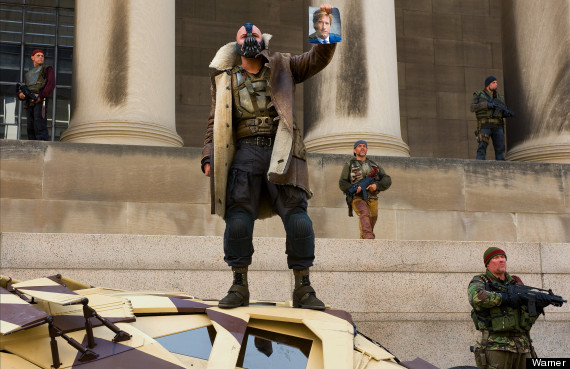
The Dark Knight Rises: A Masterpiece of White Supremacist Fantasy

Us or Them? Mad thugs bent on the destruction of civilisation wreak havoc on populations

Gotham City is taken hostage by a gang of vicious terrorists. They have crawled out of a dark hole in the Middle East, and one has even managed to pass herself off as a Gothamite. They have made common cause with 1000 Gotham prisoners in orange jumpsuits. They have managed to get hold of a device for creating nuclear power – but the wily swine have found a way to turn it into a nuclear bomb. Their crazed fanaticism means that their only use for technology is as a means of genocide. They are led by a man called Bane. His face is covered. He is a psychopath.
            It doesn’t take much decoding to work out what all this represents. It is a powerful piece of propaganda in the war against Iran. But it also taps into a much older story that white people have been telling themselves for years – the fear of being swamped by the black masses. If they are ever allowed to crawl out of their dark hole, the story goes, this is what happens. They will get into our societies. They will mix with us. Then they will destroy us.
            Of course, these fears disguise the fact that it is precisely us, the white nations, which already do these things the world over. The film’s scenes of violent criminals being let out of prison and armed, of summary justice in mock courts, of public lynchings: this is what has just been imposed by NATO on Libya. The killing of scientists, the constant threat of all out war, the blockade of the city to intimidate the population: this is what the Europe and America are doing to Iran today. The random bomb attacks, the war against the police, the co-option of sections of the army under threat of total destruction: this is precisely the reality of the West’s proxy war against Syria.
            It is a psychological truism that what we hate most in others is what we refuse to see about ourselves. We kid ourselves that our own hatred and brutality is actually an attribute of our victims: and thus justify their destruction. We imagine they are as bad as us.
            What makes us so convinced – without even five minutes serious study or thought on the issue – that Gaddafi, or Assad, or Ahmadinejad is a bloodthirsty murderous tyrant?  We don’t feel the need to look into specifics – because we know their type. We have grown up with these archetypal evil figures – we know them from the movies and stories we’ve been telling each other our whole lives. We know exactly what these people are like. What we don’t necessarily want to accept is that these archetypes are actually based on ourselves. However successful we may be at keeping the fact out of our conscious minds, we know, in our hearts, what genocidal depravities underpin, and have always underpinned, Western/ white supremacy in the world. Our most honoured national figures are open supporters of genocide. We know we are bloodthirsty murderous tyrants. But the stories we tell our children – stories such as the Dark Knight Rises – allow us to project these qualities onto our enemies. When we wage war, it is not against ‘Gaddafi’, but the imagined Gaddafi, the one we know very well – because the imagined Gaddafi is us.
            The battle ends with scenes of euphoria as the jubilant Gothamites cheer on a mushroom cloud from a nuclear bomb dropped over the sea (overseas?). Of course, in the film, no one actually dies in this explosion - but isn’t that exactly what we tell ourselves about our wars anyway? No one really dies at our hands – no one of any consequence anyway – only demons, Gaddafi-ites, insurgents; sub-humans. Won’t the war against Iran just involve a ‘surgical strike’ against ‘facilities’? We will be able to find a way to applaud the overseas mushroom cloud, one way or another; after all, we will say – it’s no worse than what they would do to us. Don’t you know what these people are like? Haven’t you seen Batman?

Wednesday, 15 August 2012

When are humans not human? Libya, Liberalism and the incineration of the armies of the global South


Ever since its inception in the seventeenth century, liberalism has been a wholly hypocritical ideology, based not on the principle of the indivisibility of humanity, as its adherents claim, but on precisely the opposite - endlessly redefined categories of exclusion. The founder of modern Liberalism, John Locke, formulated the principles of England’s ‘Glorious Revolution’ of 1688, supposedly entrenching the ‘natural rights’ to “life, liberty and property” with which he believed all humans were born. All that is, except Catholics - whose support for the wrong side in the English civil war was to be the pretext for the denial of their basic rights for the next 150 years - and Africans, who, by a simple logical trick, were simply categorised by Locke as not human at all.

Ever since then, Liberalism’s so-called “universal” human rights have been anything but; Locke’s exceptions have become the rule. A century after the ‘Glorious Revolution’, the USA’s founding fathers followed up their victory in the war against English rule by enshrining basic liberal values into their new constitution. This time “life, liberty and the pursuit of happiness” were the human rights to which all were entitled. Following Locke, the continuation of slavery presented no contradiction here – Africans were simply written off as not fully human – only three fifths human, in fact – and thus exempt from the ‘natural rights’ inherent to all men.

In our times, the ideological somersault has been slightly more subtle than the simple demonization of Africans or Catholics. The people now deemed unworthy of even the most basic human right – the right to life – are soldiers. This is the barbaric flipside of all the feigned concern for civilians in Syria and Libya that has been pouring out of the mouths of our politicians and media pundits for the past year.

This focus on civilians is intentionally designed to hide the horrific reality of what has actually been taking place – the systematic strafing and murder of Libyan and Syrian troops in their tens of thousands – troops who have never invaded another country, many of whom have not even been involved in the retaking of rebel cities, and most still in their teens.

Of course, civilians were killed by NATO as well - and not just mistakenly either. Defence Secretary Liam Fox effectively admitted that Gaddafi’s baby grandchildren (all aged between 6 months and 2 years), blown to pieces by NATO in late April last year, were deliberately targeted as part of a strategy to “put psychological pressure on Gadaffi”. But these deaths were at least reported as deaths in the Western media, and briefly caused some controversy. Likewise, the Guardian reported on its front page the news that NATO had deliberately left 61 migrants to die of thirst in the Mediterranean, some of the 1500 civilians estimated to have died there whilst attempting to flee NATO’s war.

Deaths of Libyan soldiers, however, were never reported by Western news corporations as deaths of human beings. At best, there were veiled references to the ‘degrading of Gaddafi’s military capability’ or of ‘Gaddafi’s capacity to attack civilians’. The latter is particularly odious. Soldiers have become, it seems, not human beings - people with lives, feelings and families – but merely the ‘capacity to attack civilians’.

Barely six weeks into the invasion, British officials were already boasting that NATO had killed over 35,000 such human beings (in the usual euphemistic way, of course - “We estimate that [Gaddafi] has around 30 per cent of his ground forces capability remaining,” is how one British official put it, after estimating an initial ‘capability’ of 50,000).

The ideological focus on civilians and no one else does not take much decoding. It is clearly an exclusionary category – civilians are precisely not-soldiers. Therefore the statement “when we bomb Libya, we are going to save civilians” might be a more palatable way of saying “we are going to incinerate all 50,000 members of the Libyan armed forces”, but essentially means exactly the same thing: no soldiers will be spared.

Of course, the massacre of male soldiers also helped to facilitate the slaughter of NATO’s beloved civilians as well, as women and children were left – and remain - even more vulnerable to the rebel army’s rapes and murders after the killing of their husbands and fathers.

We need to challenge this rhetoric about civilian lives, as if no one and nothing else is important. The obsessive focus not only wilfully obscures the massacres of Libyan soldiers, but also justifies the destruction of their economy, infrastructure, telecommunications networks, water supply… once we accept the logic that only civilian lives are important, literally every other possible target becomes fair game.

Of course, when British soldiers get killed, the euphemisms end. When the Taliban “degrade” the British army’s “capacity to attack civilians”, this is not how it appears in the headlines. British soldiers have names, faces, families, and of course, a just cause. Soldiers of the occupying army are always human, no matter what atrocities they have taken part in; Libyan soldiers are never human – even if they have never fired a shot in their life.

In Syria, the redefining of the English language has become even more tortuous. Until recently, the Western press rarely admitted that the SAS-trained and CIA-funded death squads even had weapons, let alone that they were using them to wage war against any and all supporters of Syria’s secular state. Armed men using brutal sectarian violence were instantly whitewashed to become ‘peaceful protesters’ unjustly victimised by the Syrian army. Death figures were reported as if any and all casualties were ‘civilians’ killed by ‘Assad’s forces’. Thus, whilst in Libya, soldiers’ deaths did not ‘count’, in Syria it is even worse – police and soldiers’ deaths are counted – not as victims of the West’s proxies who actually killed them, but as victims of themselves, of the Syrian state. Even the heavily anti-government Syrian Observatory for Human Rights admits that well over 5000 Syrian soldiers and police have been killed by rebels, with massacres of 80-100 at a time not uncommon. But Western reporting tends to lump these deaths together with figures of rebels killed to produce an overall death rate it attributes solely to the Syrian government. Thus are statistics used to demonise the murdered and build support for their killers.

This dehumanisation of soldiers should come as no surprise. British soldiers too – lionised by politicians and media once dead – are treated as thoroughly expendable whilst alive. The institutionalised bullying – and probable murder – at the Deepcut barracks, the lack of effective post-tour emotional support, and the massive presence of former soldiers amongst the growing army of Britain’s homeless are all indicative of a ruling class that treats even its own soldiers with contempt. Many of the RAF crews who carried out the slaughter of the Libyan army actually returned home to find themselves being made redundant. Empire has no loyalty to its servants. Indeed, last year, a judgement by the highest court in the land ruled that British soldiers were in fact officially not human – or at least, not covered by the Human Rights Act – after privates were forced by their superior officers into harsh conditions that eventually killed them.

Despite this shoddy treatment of British soldiers, however, it remains the armies of the global South who are the primary targets of demonization and total destruction. The new ideological focus on civilians is just a new disguise for Liberalism’s age-old racism, with a little twist to make it more politically correct. In the nineteenth century, non-white peoples were portrayed as subhuman. Today’s humanitarian crusaders claim to love those peoples, of course: it’s just their armies – their only source of protection - that they want to destroy. 

An edited version of this article originally appeared in the Morning Star.


Friday, 25 May 2012

Libya, Africa, and Africom: an ongoing disaster


The destruction of Libya as an independent regional power has paved the way for the military re-conquest of Africa.
 
NATO's Libyan mercenaries demonstrate whose side they are on in the struggle between white power colonialism and African liberation.

The scale of the ongoing tragedy visited on Libya by NATO and its allies is becoming horribly clearer with each passing day. Estimates of those killed so far vary, but 50,000 seems like a low estimate; indeed the British Ministry of Defence was boasting that the onslaught had killed 35,000 as early as last May. But this number is constantly growing. The destruction of the state’s forces by British, French and American blitzkrieg has left the country in a state of total anarchy - in the worst possible sense of the word. Having had nothing to unite them other than a temporary willingness to act as NATO’s foot soldiers, the former ‘rebels’ are now turning on each other. 147 were killed in in-fighting in Southern Libya in a single week earlier this year, and in recent weeks government buildings – including the Prime Ministerial compound – have come under fire by ‘rebels’ demanding cash payment for their services. $1.4billion has been paid out already – demonstrating once again that it was the forces of NATO colonialism, not Gaddafi, who were reliant on ‘mercenaries’- but payments were suspended last month due to widespread nepotism. Corruption is becoming endemic – a further $2.5billion in oil revenues that was supposed to have been transferred to the national treasury remains unaccounted for. Libyan resources are now being jointly plundered by the oil multinationals and a handful of chosen families from amongst the country’s new elites; a classic neo-colonial stitch-up. The use of these resources for giant infrastructure projects such as the Great Manmade River, and the massive raising of living standards over the past four decades (Libyan life expectancy rose from 51 to 77 since Gaddafi came to power in 1969) sadly looks to have already become a thing of the past.
            But woe betide anyone who mentions that now. It was decided long ago that no supporters of Gaddafi would be allowed to stand in the upcoming elections, but recent changes have gone even further. Law 37, passed by the new NATO-imposed government last month, has created a new crime of ‘glorifying’ the former government or its leader – subject to a maximum sentence of life imprisonment. Would this include a passing comment that things were better under Gaddafi? The law is cleverly vague enough to be open to interpretation. It is a recipe for institutionalised political persecution.
            Even more indicative of the contempt for the rule of law amongst the new government – a government, remember, which has yet to receive any semblance of popular mandate, and whose only power base remains the colonial armed forces – is Law 38. This law has now guaranteed immunity from prosecution for anyone who committed crimes aimed at “promoting or protecting the revolution”. Those responsible for the ethnic cleansing of Tawergha – such as Misrata’s self-proclaimed “brigade for the purging of black skins” - can continue their hunting down of that cities’ refugees in the full knowledge that they have the new ‘law’ on their side. Those responsible for the massacres in Sirte and elsewhere have nothing to fear. Those involved in the widespread torture of detainees can continue without repercussions – so long as it is aimed at “protecting the revolution” – i.e. maintaining NATO-TNC dictatorship.
            This is the reality of the new Libya: civil war, squandered resources, and societal collapse, where voicing preference for the days when Libya was prosperous and at peace is a crime, but lynching and torture is not only permitted but encouraged.
            Nor has the disaster remained a national one. Libya’s destabilisation has already spread to Mali, prompting a coup, and huge numbers of refugees – especially amongst Libya’s large black migrant population - have fled to neighbouring countries in a desperate attempt to escape both aerial destruction and lynch mob rampage, putting further pressure on resources elsewhere. Many Libyan fighters, their work done in Libya, have now been shipped by their imperial masters to Syria to spread their sectarian violence there too.
            Most worrying for the African continent, however, is the forward march of AFRICOM – the US military’s African command – in the wake of the aggression against Libya. It is no coincidence that barely a month after the fall of Tripoli – and in the same month Gaddafi was murdered (October 2011) - the US announced it was sending troops to no less than four more African countries – the Central African Republic, Uganda, South Sudan and the Democratic Republic of Congo. AFRICOM have now announced an unprecedented fourteen major joint military exercises in African countries for 2012. The military re-conquest of Africa is rolling steadily on.
            None of this would have been possible whilst Gaddafi was still in power. As founder of the African Union, its biggest donor, and its one-time elected Chairman, he wielded serious influence on the continent. It was partly thanks to him that the US was forced to establish AFRICOM’s HQ in Stuttgart in Germany when it was established in February 2008, rather than in Africa itself; he offered cash and investments to African governments who rejected US requests for bases. Libya under his leadership had an estimated $150 billion of investments in Africa, and the Libyan proposal, backed with £30billion cash, for an African Union Development Bank would have seriously reduced African financial dependence on the West. In short, Gaddafi’s Libya was the single biggest obstacle to AFRICOM penetration of the continent.
            Now he has gone, AFRICOM is stepping up its work. The invasions of Iraq and Afghanistan showed the West that wars in which their own citizens get killed are not popular; AFRICOM is designed to ensure that in the coming colonial wars against Africa, it will be Africans who do the fighting and dying, not Westerners. The forces of the African Union are to become integrated into AFRICOM under a US-led chain of command. Gaddafi would never have stood for it; that is why he had to go.
            And if you want a vision of Africa under AFRICOM tutelage, look no further than Libya, NATO’s model of an African state: condemned to decades of violence and trauma, and utterly incapable of either providing for its people, or contributing to regional or continental independence. The new military colonialism in Africa must not be allowed to advance another inch.

This article first appeared in Counterpunch.


Wednesday, 2 May 2012

SYRIA: THE WEST’S GREATEST FEAR IS A PEACEFUL RESOLUTION TO THE CRISIS


Another 20 killed in Idlib by NATO's proxy forces, 31 April 2012

 The strategy was simple, clear, tried and tested. It had been used successfully not only against Libya, but also Kosovo (in 1999), and was rapidly under way in Syria. It was to run as follows: train proxies to launch armed provocations; label the state’s response to these provocations as genocide; intimidate the UN Security Council into agreeing that “something must be done”; incinerate the entire army and any other resistance with fragmentation bombs and Hellfire missiles; and finally install a weak, compliant government to sign off new contracts and alliances drawn up in London, Paris and Washington, whilst the country tears itself apart. Result: the heart torn out of the ‘axis of resistance’ between Iran, Syria and Hezbollah, leaving Iran isolated and the West with a free hand to attack the Islamic republic without fear of regional repercussions.


This was to be Syria’s fate, drawn up years ago in the high level planning committees of US, British and French defence departments and intelligence services. But this time, unlike in Libya, it has not all gone according to plan.


First, there was Russia and China’s veto of the 'regime change' resolution at the UN Security Council in October 2011, followed by a second veto in February of this year. This meant that any NATO attack on Syria would be denied the figleaf of UN approval, and seen instead as a unilateral act of aggression - not just against Syria, but potentially against China and Russia as well. Vicious and reckless as they are, even Cameron, Sarkozy and Obama do not necessarily have the stomach for that kind of a fight. That left the burden of destroying the Syrian state to NATO’s proxy forces on the ground, the ‘Free Syria Army’ – a collection of domestic and (increasingly) foreign rival armed militias, mostly ultra-sectarian Salafi extremists, along with a smattering of defectors and Western special forces. 


However, this army was not created to actually defeat the Syrian state; that was always supposed to be NATO’s job. As in Libya, the role of the militias was simply to provoke reprisals from the state in order to justify a NATO blitzkrieg. Left to their own devices, they have no chance of gaining power militarily, as many in the opposition realise. "We don't believe the Free Syrian Army is a project that can help the Syrian revolution," said the leader of the internal peaceful Syrian resistance movement, Haytham Al-Manna, recently, "we don't have an example where an armed struggle against a dictatorial regime won." Of course, one could cite Cuba, South Vietnam, and many others; but what is certainly true is that internal armed struggle alone has never succeeded when the government is the only single party in the struggle with any significant mass support - such as in Syria. 


This reality was brutally driven home in early March, in the decisive battle for the Baba Amr district of Homs. This was supposedly one of the Free Syrian Army’s strongholds, yet they were roundly defeated, leaving them facing the prospect of similar defeats in their last few remaining territories as well. The opposition are increasingly aware that their best chance of meaningful change is not through a military fight that they will almost certainly lose – and which will get them killed in the process, along with their support and credibility – but through negotiations and participation in the reform process and dialogue which the government has offered. 


This prospect – of an end to the civil war, and a negotiated peace which brings about a reform process without destabilising the country – has led to desperation amongst the imperial powers. Despite their claims to the contrary, a stable Syrian-led process is the last thing they want, as it leaves open the possibility of Syria remaining a strong, independent, anti-imperialist state – exactly the possibility they had sought to eliminate.


Hence, within days of Kofi Annan’s peace plan gaining a positive response from both sides in late March, the imperial powers openly pledged, for the first time, millions of dollars for the Free Syrian Army: for military equipment, to provide salaries to its soldiers, and to bribe government forces to defect. In other words, terrified that the civil war is starting to die down, they are setting about institutionalising it. If violent regime change is starting to look unlikely, the hope instead is to keep the country weak and on its knees by keeping its energy sucked into civil war.


At the risk of making the Syrian National Council appear even more out of touch with ordinary Syrians than it does already, its Western backers have increased the pressure for them to fall into line with this strategy, leading to open calls from the SNC leadership for both the full scale arming of the rebellion, and for aerial bombardment from the West. This has caused huge rifts in the organisation, with three leading members defecting last month, because they did not want to be "accomplices to the massacre of the Syrian people through delaying, cheating, lies, one-upmanship and monopolisation of decision-making." The SNC, according to one of the three, Kamal al-Labwani , was "linked to foreign agendas which aim to prolong the battle while waiting ... for the country to be dragged into a civil war."


This month one of the very few SNC leaders actually based in Syria, Riad Turk, called on the opposition to accept the Annan peace plan, “stop the bloodshed” and enter dialogue with the government – a call not echoed by his fellow SNC colleagues abroad. Likewise, the main peaceful opposition grouping based within Syria – the National Co-ordinating Committee – has fallen out with the SNC over the latters’ increasingly belligerent role as a mouthpiece of foreign powers. NCC leader Haytham Al-Manna spoke out publicly against the Free Syrian Army recently, saying, "The militarization of the Syrian revolution signifies the death of the internal revolution…We know that the Turkish government plays an important role in the political decisions of the Free Syrian Army. We don't believe that an armed group can be on Turkish territory and remain independent of Turkish decisions."


So there is a growing perception, even amongst the Syrian opposition movement itself, that both the Free Syrian Army and the Syrian National Council are working in the interests of foreign powers to prolong a pointless civil war. 


Western policy makers are playing a dangerous game. Short of a NATO attack, their best option for the destabilisation and emasculation of Syria is to ensure that the ceasefire fails and the fighting continues. To this end, they are encouraging their proxy militias to step up their provocations; the purpose of Clinton and Juppe’s statements about “other measures” still being on the table is to keep the idea of a NATO attack alive in the heads of the rebels so that they continue to fight. Indeed, many more foreign fighters have been shipped into the country in recent weeks according to the Washington Post, and have been launching devastating bomb attacks in Damascus and Aleppo. US ambassador to Syria, Robert Ford is a protégé of John Negroponte, who organised contra death squads to destabilise Nicaragua in the 1980s; he will almost certainly have been organising similar groups in Syria during his time there last year, for similar purposes. 


Nevertheless, the destabilisation agenda is not going according to plan. The internal opposition are becoming increasingly frustrated with the way things are progressing, and a clear split is emerging between those based outside the country, happy to see Syria consigned to oblivion in order to please their paymasters and further their careers, and those who actually have to live with the consequences. The reckless attacks of the armed militias are increasingly alienating even those who once had some sympathy for them, especially as their foreign membership and direction is exposed ever more clearly. Having been proven decisively unable to win and hold territory, these militias are turning to hit-and-run guerrilla tactics. But the guerrilla, as Mao put it, is like a fish, which can only survive in a sea of popular support. And that sea is rapidly drying up.           


Friday, 9 December 2011

The West aims to turn the entire global South into a failed state.

Private security is one of the few industries in which the Western world still has a competitive advantage


The economic collapse that began in 2008, that was duly declared unpredictable and thoroughly unforeseen across the entire Western media, was in fact anything but. Indeed, the capitalist cycle of expansion and collapse has repeated itself so often, over hundreds of years, that its existence is openly accepted across the whole spectrum of economic thought, including in the mainstream - which refers to it, in deliberately understated terms, as the “business cycle”. Only those who profit from our ignorance of this dynamic – the billionaire profiteers and their paid stooges in media and government – try to deny it.

A slump occurs when “capacity outstrips demand” – that is to say, when people can no longer afford to buy all that is being produced. This is inevitable in a capitalist system, where productive capacity is privately owned, because the global working class as a whole are never paid enough to purchase all that they collectively produce. As a result, unsold goods begin to pile up, and production facilities – factories and the like – are closed down. People are thrown out of work as a result, their incomes decline, and the problem gets worse. This is exactly what we are seeing happen today.

In these circumstances, avenues for profitable investment dry up - the holders of capital can find nowhere safe to invest their money. For them, this is the crisis – not the unemployment, the famine, the poverty etc (which, after all, remain an endemic feature of the global capitalist economy even during the ‘boom times’, albeit on a somewhat reduced scale). The governments under their control – through ownership of the media, currency manipulation and control of the economy – must then set to work creating new profitable investment opportunities.

One way they do this is by killing off public services, and thus creating opportunities for investment in the private companies that replace them. In 1980s Britain, Margaret Thatcher privatised steel, coal, gas, electricity, water, and much else besides. In the short term, this plunged millions into unemployment, as factories and mines were closed down, and in the long term it resulted in massive price rises for basic services. But it had its intended effect – it provided valuable investment opportunities (for those with capital to spare) at a time when such opportunities were scarce, and created a long term source of fabulous profits. This summer, for example, saw the formerly publicly owned gas company Centrica hiking its prices by another 18% to bring in a £1.3billion profit. The raised prices will see many thousands more pensioners than usual die from the cold this winter as a result, but gas – like all commodities in capitalist society – is not there to provide heat, but to increase capital.

In the global South, privatisation was harsher still. Bodies like the IMF and the World Bank used the leverage provided by the debt-extortion mechanism (whereby interest rates were hiked on unpayable loans that had rarely benefited the population, often taken out by corrupt rulers imposed by Western governments in the first place) to force governments across Asia, Africa and Latin America to cut public spending on even basics such as health and education, along with agricultural subsidies. This contributed massively to the staggering rates of infant mortality and deaths from preventable disease, as well as to the AIDS epidemic now raging across Africa. But again the desired end for those imposing the policies was achieved, as new markets were created and holders of giant capital reserves could now invest in private companies to provide the services no longer available from the state. The profit system was given a new lease of life, its collapse staved off once again.

The World Bank’s closure of the Indian government’s grain rationing and distribution service, for example, meant that a scheme providing affordable grain to all Indian citizens was closed down, allowing private companies to come in and sell grain at massively increased prices (sometimes up to ten times higher). Whilst this has led to huge numbers of Indians being priced out of the market, and a resulting 200 million people now facing starvation in India, it has also led to record profits for the giant private companies now holding the world’s grain stocks – which is the whole point.

This round of global privatisation from the 1980s onwards, however, was so thorough that when the 2008 crisis hit, there were few state functions left to privatise. Creating investment opportunities now is much trickier than it was thirty years ago, because so much of what is potentially profitable is already being thoroughly exploited as it is.

In Europe, what is left of public services is hastily being dismantled, as right wing political leaders happily privatise what is left of the public sector, and currency speculators use their firepower to pick off any country that attempts to resist. David Cameron, following the path forced on the global South over recent decades, for example, is busy opening up Britain’s National Health Service to private companies, and massively cutting back on public service provision for vulnerable groups such as the elderly and the jobless.

In the global South, however, there is little left for the West to privatise, as successive IMF policies have long ago forced those countries in their grip to strip their public services to the bone (and beyond) already.

But there is one state function which, if fully privatised across the world, would make the profits made even from essentials such as healthcare and education look like peanuts. That is the most basic and essential state function of all, indeed the whole raison d’etre for the state: security.

Private security companies are one of the few growth areas during times of global recession, as growing unemployment and poverty leads to increased social unrest and chaos, and those with wealth become more nervous about protecting both themselves, and their assets. Furthermore, as the Chinese economy advances at a rate of knots, military superiority is fast becoming the West’s only “competitive advantage” – the one area in which it’s expertise remains significantly ahead of its rivals. Turning this advantage, therefore, into an opportunity for investment and profit on a large-scale is now one of the chief tasks facing the rulers of Western economies.

A recent article in the Guardian noted that British private security firm Group 4 is now “Europe's largest private sector employer”, employing 600,000 people - 50% more than make up the total armed forces of Britain and France combined. With growth last year of 9% in their “new markets” division, the company have “already benefited from the unrest in north Africa and the Middle East.” Group 4 are set to make a killing in Libya, following the total breakdown of security, likely to last for decades, resulting from NATO’s incineration of the country’s armed forces and wholesale destruction of its state apparatus. With the rule of law replaced by warfare between rival gangs of rebels, and no realistic prospect of a functioning police force for the foreseeable future, those Libyans able to manoeuvre themselves into positions of wealth and power will likely have to rely on private security for many years to come.

When Philip Hammond, Britain’s new Defence Secretary and a multi-millionaire businessman himself, suggested that British companies “pack their suitcases and head to Libya”, it was not only oil and construction companies he had in mind, but private security companies.

Private military companies are also becoming huge business – most famously, the US company Blackwater, renamed Xe Services after its original name became synonymous with the massacres committed by its forces in Iraq. In the USA, Blackwater has already taken over many of the security functions of the state – charging the Department of Homeland Security $1000 per day per head in New Orleans after Hurricane Katrina, for example. “When you ship overnight, do you use the postal service or do you use FedEx?” asked Erik Prince, founder and chairman of Blackwater. “Our corporate goal is to do for the national security apparatus what FedEx did to the postal service”. Another Blackwater official commented that “None of us loves the idea that devastation became a business opportunity. It’s a distasteful fact. But that’s what it is. Doctors, lawyers, funeral directors, even newspapers – they all make a living off of bad things happening. So do we, because somebody’s got to handle it.”

The danger comes when the economic climate is such that the world’s most powerful governments feel they must do all they can to create such business opportunities. During the Cold War, the US military acted (as indeed it still does) to keep the global South in a state of poverty by attacking any government that seriously sought to challenge this poverty, and imposing governments that would crush trade unions and keep the population cowed. This created investment opportunities because it kept the majority of the world’s labour force in conditions so desperate they were willing to work for peanuts. But now this is not enough. In slump conditions, it doesn’t matter how cheap your workforce is if nobody is buying your products. To create the requisite business opportunities today – a large global market for its military expertise - Western governments must impose not only poverty, but also devastation. Devastation is the quickest route to converting the West’s military prowess into a genuine business opportunity that can create a huge new avenue for investment when all others are drying up. And this is precisely what is happening.  David Cameron is, for once, telling the truth, when he says “Whatever it takes to help our businesses take on the world – we’ll do it.”

As The Times put it recently, “In Iraq, the postwar business boom is not oil. It is security.” In both Iraq and Afghanistan, a situation of chronic and enduring instability and civil war has been created by a very precise method. Firstly, the existing state power is totally destroyed. Next, the possibility of utilising the country’s domestic expertise to rebuild state capacity is undermined against by barring former officials from working for the new government (a process known in Iraq as “de-Ba’athification”). Linked to this, the former ruling party is banned from playing any part in the political process, effectively ensuring that the largest and most organised political formation in each country has no option but to resort to armed struggle to gain influence, and thereby condemning the country to civil war. Next, vicious sectarianism is encouraged along whatever religious, ethnic and tribal divisions are available, often goaded by the covert actions of Western intelligence services. Finally, the wholesale privatisation of resources ensures chronically destabilising levels of unemployment and inequality.  The whole process is self-perpetuating, as the skilled and professional sections of the workforce – those with the means and connections – emigrate, leaving behind a dire skills shortage and even less chance of a functioning society emerging from the chaos.

This instability is not confined to the borders of the state which has been destroyed. In a masterfully cynical domino effect, for example, the aggression against Iraq has also helped to destabilise Syria. Three quarters of the 2 million Iraqi refugees fleeing the war in their own country have ended up in Syria, thus contributing to the pressure on the Syrian economy which is a major factor in the current unrest there. 

The destruction of Libya will also have far reaching destabilising consequences across the region. As the recent United Nations Support Mission in Libya stated, “Libya had accumulated the largest known stockpile of Manpads [surface-to-air missiles] of any non-Manpad-producing country. Although thousands were destroyed during the seven-month Nato operations, there are increasing concerns over the looting and likely proliferation of these portable defence systems, as well as munitions and mines, highlighting the potential risk to local and regional stability.” Furthermore, a large number of volatile African countries are currently experiencing a fragile peace secured by peacekeeping forces in which Libyan troops had been playing a vital role. The withdrawal of these troops may well be damaging to the maintenance of the peace. Similarly, Libya, under Gaddafi’s rule, had contributed generously to African development projects; a policy which will certainly be ended under the NTC – again, with potentially destabilising consequences.

Clearly, a policy of devastation and destabilisation fuels not only the market for private security, but also for arms sales – where, again, the US, Britain and France remain market leaders. And a policy of devastation through blitzkrieg fits in clearly with the big three current long term strategic objectives of Western policy planners:

  1. To corner as large a share as possible of the world’s diminishing resources, most importantly oil, gas and water. A government of a devastated country is at the mercy of the occupying country when it comes to contracts. Gaddafi’s Libya, for example, drove a notoriously hard bargain with the Western powers over oil contracts – acting as a key force in the 1973 oil price spike, and still in 2009 being accused by the Financial Times of “resource nationalism”. But the new NTC government in Libya have been hand picked for their subservience to foreign interests – and know that their continued positions depend on their willingness to continue in this role.
  2. To prevent the rise of the global South, primarily through the destruction of any independent regional powers (such as Iran, Libya, Syria etc) and the destabilisation, isolation and encirclement of the rising global powers (in particular China and Russia).
  3. To overcome or limit the impact of economic collapse by using superior military force to create and conquer new markets through the destruction and rebuilding of infrastructure and the elimination of competition.

This policy of total devastation represents a departure from the Cold War policies of the Western powers. During the Cold War, whilst the major strategic aims remained the same, the methods were different. Independent regional powers in the global South were still destabilised and invaded – and regularly – but generally with the aim of installing ‘compliant dictatorships’. Thus, Lumumba was overthrown and replaced with Mobutu; Sukarno with Suharto; Allende with Pinochet; etc etc. But the danger with this ‘imposed strongmen’ policy was that strongmen can become defiant. Saddam Hussein illustrated this perfectly. After having been backed for over a decade by the West, he turned on their stooge monarchy in Kuwait. Governments that are in control can easily get out of control. However, for as long as these strongmen were needed for the services provided by their armies (protecting investments, repressing workers struggles, etc), they were supported. The crisis now underway in the economies of the West, however, calls for more drastic measures. And the development of private security and private mercenary companies mean that the armies provided by these strongmen are starting to be deemed no longer necessary.

Congo is a case in point. For three decades, the Western powers had supported Mobutu Sese-Seko’s iron rule of the Congo. But then, in the mid-90s, they allowed him to be overthrown. However, rather than allowing the Congolese resistance forces to take power and establish an effective government, they then sponsored an invasion of the country by Uganda, Rwanda and Burundi. Although these countries have now largely withdrawn their militias, they continue to sponsor proxy militias which have prevented the country seeing a moment’s peace for nearly fifteen years, resulting in the biggest slaughter since the end of the Second World War, with over 5 million killed. One result of this total breakdown of functioning government has been that the Western companies that loot Congo’s resources have been able to do so virtually for free. Despite being the world’s largest supplier of both coltan and copper, amongst many other precious minerals, the total tax revenue on these products in 2006-7 amounted to a puny £32 million. This is surely far less than what even the most useless neo-colonial puppet would have demanded. 

This completely changes the meaning of the word ‘government’. In the Congo, the government’s best efforts to stabilise and develop the country have so far proved no match for the destabilisation strategies of the West and its stooges. In Afghanistan, it is well known that the government’s writ has no authority outside of Kabul, if there. But then, that is the point. The role of the governments imposed on Afghanistan, Iraq and Libya, like the one they are trying to impose on Syria, is not to govern or provide for the population at all - even that most basic of functions, security. It is simply to provide a figleaf of legitimacy for the occupation of the country and to award business contracts to the colonial powers. They literally have no other function, as far as their sponsors are concerned.

It goes without saying that this policy of devastation is turning the victimised countries into a living hell. After now more than thirty years of Western destabilisation, and ten years of outright occupation, Afghanistan is at or very hear the bottom of nearly every human development indicator available, with life expectancy at 44 years and an under-five mortality rate of over one in four. Mathew White, a history professor who has recently completed a detailed survey of the humanity’s worst atrocities throughout history, concluded that, without doubt, “chaos is far deadlier than tyranny”. It is a truth to which many Iraqis can testify.

This article originally appeared in Dissident Voice.